
Off-Plan Payment Schedule in Vietnam: How Installments Work for Foreign Buyers (2026)
Buying an off-plan apartment in Vietnam means paying for a home that does not exist yet — in stages, over 18 to 36 months, as the building rises floor by floor. For a foreign buyer that raises an obvious question: when exactly does the money leave your account, how much at each step, and what does each payment actually buy you? This guide walks through the real off-plan payment schedule for future housing in Vietnam in 2026 — the reservation deposit, the staged installments tied to construction, the legal caps that protect you, the foreign-currency mechanics, and what happens if a payment is missed.
This is general information for 2026, not legal, tax, or investment advice. Vietnamese real estate law is applied through decrees, circulars, and local practice that change, and every developer’s contract differs. Always have a licensed Vietnamese lawyer review your specific project and sale contract before you pay anything.
How off-plan payment works in Vietnam, in one picture
In Vietnamese law, an apartment under construction is future housing (nhà ở hình thành trong tương lai) — a home formed in the future. Because it does not physically exist, you cannot pay for it all at once and take the keys. Instead, the developer collects the price in installments that track construction progress, and the Law on Real Estate Business 2023 (effective 1 August 2024) caps how much can be collected, and when.
The logic is straightforward: the more of the building that exists, the more of your money the developer is allowed to hold. You never pay 100% for a building that is still a hole in the ground, and you keep a small final slice until the ownership paperwork — the pink book (sổ hồng) — is in your name. The whole schedule is written into your Sale and Purchase Agreement (SPA) before you commit, so you should know every payment date and amount up front.
If you are still deciding whether off-plan is right for you at all, read off-plan vs completed property in Vietnam first. This guide assumes you have chosen off-plan and want to understand the cash flow.
The four legal caps every foreign buyer should memorise
Before the milestones, learn the four numbers. They are the guardrails of the whole schedule, and a compliant developer cannot cross them.
| Cap | Limit | What it means for you |
|---|---|---|
| Reservation deposit | ≤ 5% of price before the SPA is signed | No developer can take more than 5% to “hold” the unit before the contract exists. |
| First installment | ≤ 30% of contract value (deposit counts toward this) | Your first real payment at signing, including the deposit already paid, can’t exceed 30%. |
| Total before handover | ≤ 70% (domestic developer) / ≤ 50% (foreign-invested developer) | The most the developer can collect before giving you the keys. |
| Before the pink book | ≤ 95% of price | The seller can’t collect the final ~5% until your ownership certificate is issued. |
These reflect the structure of the Law on Real Estate Business 2023 (the 5% deposit cap sits in Article 23, and the prepayment limits and 95% rule sit in the contract-of-sale provisions). For a lease-purchase arrangement (rent-to-own), a separate rule caps prepayment before handover at 50% regardless of who the developer is.
Two things foreign buyers often miss. First, the 50% before-handover cap applies when the developer itself is a foreign-invested economic organisation — many large branded developments in Vietnam are domestic-controlled and therefore use the 70% cap, but always confirm which applies to your project. Second, the 95% rule is a genuine protection, not a formality: retaining roughly 5% until the pink book is issued is your main leverage to make the developer actually deliver the certificate, which can take many months after handover.
Step by step: what each payment unlocks
Here is the typical journey from “I want this unit” to “the pink book is mine.” Exact percentages vary by developer and payment track, but the sequence and the caps are consistent.
Step 1 — Reservation / booking (a few percent, often a fixed amount)
You pay a small booking to take the unit off the market while paperwork is prepared — sometimes a fixed sum (tens of millions of dong), sometimes a couple of percent. This is a hold, not a purchase. It should always be rolled into your 5% deposit when you sign, and the agreement should state clearly whether and how it is refundable if you walk away or if the project fails to meet its sale conditions.
Step 2 — Deposit / reservation agreement (up to 5%)
When you sign the deposit or reservation agreement, your total paid reaches at most 5% of the price. By law the developer cannot take more than this before the SPA. At this stage you should already be checking that the project is legally eligible for off-plan sale and is covered by a bank guarantee — see off-plan bank guarantee in Vietnam, which is the single most important protection standing between you and a developer who runs out of money.
Step 3 — Sale and Purchase Agreement signing (first installment, up to 30% total)
Now you sign the SPA — the binding contract with the full price, the unit details, the handover date, the defect-liability period, and the entire payment schedule. Your first installment, including the 5% already paid, brings you to no more than 30% of the contract value. This is usually the largest single payment and the moment your purchase becomes real.
Step 4 — Construction-milestone installments (building up toward 50–70%)
From here you pay in tranches as the building is built. Common triggers are foundation completion, structural topping-out (the frame reaching its top floor), and finishing / fit-out. Each tranche is typically 5–15% of the price. The developer keeps collecting until you hit the before-handover ceiling — 70% for a domestic developer, 50% for a foreign-invested one.
Step 5 — Handover (up to 95% total)
When the apartment is finished and inspected, you pay the balance up to 95% and receive the keys. You can now move in, fit out, or rent the unit. Notice that even after you have the keys, you have not paid the full price — by law you cannot be required to.
Step 6 — Pink book issued (final ~5%)
Months later, once the State authority issues your ownership certificate, you pay the final retained ~5%. This is your safety net: it keeps the developer motivated to complete the legal title process, not just the physical building.
A sample payment schedule (illustrative only)
Below is an illustrative schedule for a domestic developer using a standard track, with the running total shown against the legal caps. Figures are examples — your real schedule is whatever your SPA says, within the caps.
| # | Trigger / milestone | This payment | Running total | Cap it respects |
|---|---|---|---|---|
| 1 | Booking (rolled into deposit) | 2% | 2% | within 5% deposit |
| 2 | Deposit / reservation agreement | 3% | 5% | ≤ 5% deposit |
| 3 | Sign SPA | 25% | 30% | ≤ 30% first payment |
| 4 | Foundation completed | 10% | 40% | building toward handover cap |
| 5 | Structure topped out | 15% | 55% | building toward handover cap |
| 6 | Finishing / fit-out | 15% | 70% | ≤ 70% before handover (domestic) |
| 7 | Handover of the apartment | 25% | 95% | ≤ 95% before pink book |
| 8 | Pink book (ownership certificate) issued | 5% | 100% | final retention released |
For a foreign-invested developer, the schedule is reshaped so the running total stays at or below 50% until handover — for example, smaller construction tranches, with a larger payment landing at handover. The end points (95% at handover, 100% at the pink book) stay the same; only the pre-handover ceiling drops from 70% to 50%.
Paying as a foreigner: the foreign-currency trail matters more than you think
Inside Vietnam, the apartment price is denominated and settled in Vietnamese dong, and you pay the developer in dong through the banking system. So what is different for a foreign buyer? The answer is documentation, not currency at the till.
When you bring your purchase funds into Vietnam, route them through a licensed Vietnamese bank, convert to dong, and pay the developer by bank transfer. Then keep, for every single installment, the inward-remittance receipts, conversion records, and bank statements that prove the money originated abroad. This paper trail is not bureaucratic box-ticking — it is what later allows you to repatriate your sale proceeds and any gain when you exit. When you eventually sell and try to move money out, the bank handling the outbound transfer will ask for documented proof of the original inbound investment. If you paid with cash, or with local funds you cannot trace to a foreign source, your money can end up legally yours but practically stuck in Vietnam.
A few practical points:
- Pay from your own account, ideally the same account that received your inbound transfer, so the chain is unbroken.
- Match each payment to an SPA installment in the transfer reference, so the trail is auditable.
- Never settle in physical cash for a property purchase of this size, however convenient it seems.
- Quoting in USD is common in marketing, but the contract and the actual payments are in dong; budget for exchange-rate movement between your tranches.
Our dedicated guide, transferring money to buy property in Vietnam, covers the banking channel, conversion, and repatriation paperwork in detail. Treat it as the companion to this schedule.
The bank guarantee and your installments
Every off-plan installment you pay is money handed to a developer for a home that does not exist yet. The law’s backstop is the bank guarantee for future housing: before a developer may sell off-plan, a bank must commit to refund buyers’ advance payments if the home is not handed over on the contract schedule. Since the State Bank’s Circular 61/2024 (effective 1 April 2025), the individual buyer may now choose whether a specific guarantee letter is issued for their own contract — but for a foreigner paying installments toward an unbuilt apartment, we strongly recommend keeping it. The administrative saving from waiving it is tiny next to the protection it gives every tranche you pay. Verify the guarantee before your first real installment; the full mechanics are in our off-plan bank guarantee guide.
What happens if you miss a payment
This is the part most guides skip, so be clear-eyed about it: missed-payment consequences are contractual, not statutory. They depend entirely on the default, penalty, late-interest, and termination clauses in your SPA. A typical structure looks like this:
- Grace period. The contract usually gives a short window (often two to four weeks) after the due date before you are formally in default.
- Penalty interest. Late amounts accrue interest, commonly pegged to a bank lending rate or a fixed daily rate. Vietnamese law caps contractual penalty rates, so a clause demanding a punitive rate may be unenforceable — flag it.
- Cure period and notice. Before terminating, a fair contract requires written notice and a further period to catch up.
- Termination and forfeiture. If you stay in default, the developer can terminate and forfeit part of what you have paid — frequently the deposit and sometimes more. This is the real cost of missing payments, and it is why the schedule must fit your cash flow before you sign.
Read these clauses as carefully as the price. Ask your lawyer whether the penalty and forfeiture terms are balanced — some developer templates are one-sided. And if a genuine cash-flow issue arises mid-build, talk to the developer early: many will restructure your remaining tranches rather than lose a buyer and trigger a refund claim under the bank guarantee.
Developer 0% interest and grace-period schemes — read the trade-off
To attract buyers, developers frequently offer alternative payment tracks: a long 0% interest schedule where you pay small amounts across the build, a grace period before installments start, or fast-payment discounts for paying ahead of schedule. For a foreign buyer who cannot easily obtain a Vietnamese mortgage, a genuine 0% extended track can be very useful — it spreads the cost without a finance charge.
But these are pricing tools, not gifts. The “0%” track is often offered instead of an early-payment discount, and choosing to pay faster usually earns a bigger discount on the headline price. The right way to compare is by total cash cost of each track, discounts included — not by which monthly figure feels most comfortable. Happy Land can lay a developer’s payment-scheme options side by side so you can see the real trade-off before you choose.
Putting it together
| Stage | You pay (cumulative) | What you get |
|---|---|---|
| Booking + deposit | up to 5% | Unit held; deposit agreement |
| Sign SPA | up to 30% | Binding contract, full schedule locked |
| Construction tranches | up to 50% (FDI) / 70% (domestic) | Building progresses to your milestones |
| Handover | up to 95% | Keys; you can move in or rent |
| Pink book issued | 100% | Ownership certificate in your name |
The pattern to remember: 5 → 30 → 50/70 → 95 → 100, paced to construction, with the FX trail kept clean the whole way.
General information, not advice
This guide is general information for 2026 and is not legal, tax, or investment advice. The percentages and rules above are indicative; statutory caps are applied through decrees and circulars, individual contracts vary, and figures change. Before you sign a reservation, deposit agreement, or SPA — and before you transfer any money — have a licensed Vietnamese lawyer review the project’s legal status and your specific contract, and a licensed tax adviser confirm your tax and remittance position.
If you would like Happy Land to walk you through a specific project’s payment schedule, confirm which before-handover cap applies, and lay the developer’s payment-scheme options side by side, contact us any time on Zalo or WhatsApp — we work with foreign buyers in English and can request the legal and guarantee documents before you commit a single installment. You can also browse our project listings to see current primary-market inventory.
Frequently asked questions
How much do I have to pay upfront to reserve an off-plan apartment in Vietnam?
Before you sign the actual sale and purchase agreement, a developer cannot legally take a deposit larger than 5% of the price for future (off-plan) housing under the Law on Real Estate Business 2023. In practice you pay a small reservation booking (often a fixed amount of tens of millions of dong) to hold the unit, and that booking is rolled into the 5% deposit when you sign the deposit or reservation agreement. If a salesperson asks for 10%, 20%, or 30% just to 'lock the price' before any contract exists, that is a red flag — the 5% ceiling is there to protect you.
What is the most a developer can collect before they hand over the apartment?
For future housing the law staggers it. The first installment, including your deposit, cannot exceed 30% of the contract value. The total you pay before handover cannot exceed 70% of the value for a domestic developer, or 50% for a foreign-invested (FDI-controlled) developer. And no seller may collect more than 95% of the price until you have actually received the ownership certificate (pink book / sổ hồng) — so roughly the final 5% is retained as your leverage. Any schedule that front-loads more than these caps is non-compliant.
Can I pay the developer directly in US dollars or my home currency?
Inside Vietnam, prices are denominated and settled in Vietnamese dong, and you pay the developer in dong through the banking system. What matters for you as a foreigner is the paper trail: bring your funds in from abroad through a licensed Vietnamese bank, convert to dong, and keep every inward-remittance receipt and bank statement. That documented foreign-currency origin is what later lets you repatriate your sale proceeds and any gain. Paying with cash or untraceable local funds can leave money legally yours but practically trapped in Vietnam. See our guide on transferring money to buy property in Vietnam.
What happens if I miss an installment payment?
Missed-payment consequences are contractual, not set by statute, so they depend entirely on your sale and purchase agreement. Typically the contract gives a grace period of a few weeks, charges penalty interest on the late amount (often tied to a bank lending rate or a fixed daily rate, capped by law), and — if you stay in default beyond a cure period — lets the developer terminate the contract and forfeit part of what you have paid. Always read the default, penalty, late-interest and termination clauses before you sign, and have a licensed Vietnamese lawyer flag any that are one-sided. If a genuine cash-flow problem arises, tell the developer early; many will renegotiate rather than terminate.
Are developer '0% interest' or 'grace period' payment schemes a good deal?
They can be, but read the fine print. A genuine 0% extended schedule (you pay small amounts over a long build, with no finance charge) is a real benefit for a foreign buyer who cannot easily get a Vietnamese mortgage. But many promotions trade off against the headline price: the '0%' rate is often offered instead of an early-payment discount, and choosing a faster payment track can earn a larger discount. Compare the total cash cost of each track, not just the monthly comfort. Happy Land can lay the developer's payment-scheme options side by side so you see the real trade-off.
Do foreign buyers follow a different payment schedule than Vietnamese buyers?
The statutory caps are the same, with one key difference: if the developer is a foreign-invested entity, the total it may collect before handover is 50% of the value rather than 70%. The payment milestones themselves — deposit, contract, construction stages, handover, pink book — are identical. The real foreigner-specific differences are operational, not in the schedule: routing money through the banking channel with a clean FX trail, confirming the project is within the foreign-ownership quota, and registering your leasehold ownership correctly.
Projects for sale now
Get the latest price list, availability & payment terms — free advice via Zalo/WhatsApp.
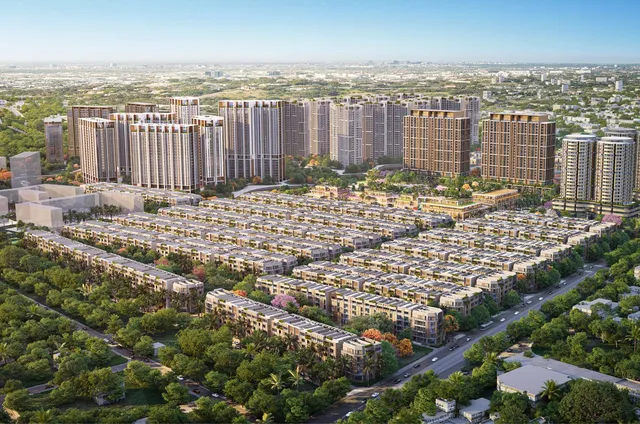 Selling now Foreign quota
 Masterise Homes · Luxury apartment & integrated township
The Global City
An Phu, Thu Duc City (former District 2), HCMC
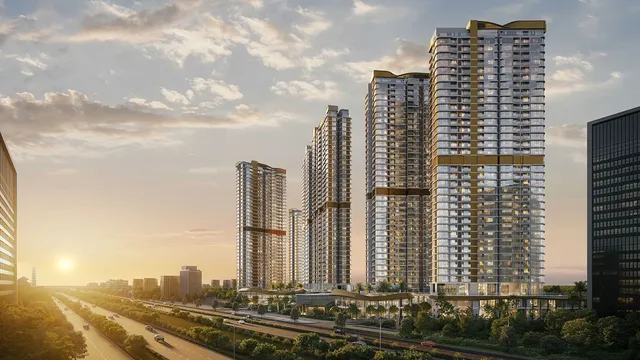 Selling now Foreign quota
 Gamuda Land · Luxury apartment
Eaton Park
An Phu, Thu Duc City, HCMC
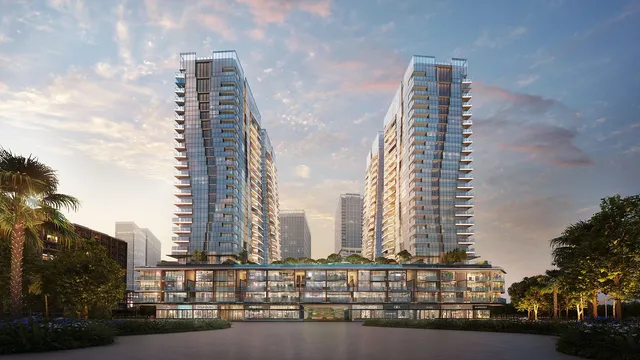 Selling now Foreign quota
 SonKim Land × Hongkong Land · Branded residences
The Metropole Thủ Thiêm
Thu Thiem, Thu Duc City, HCMC